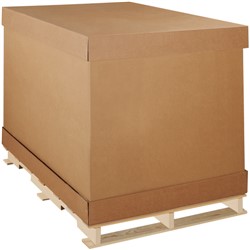
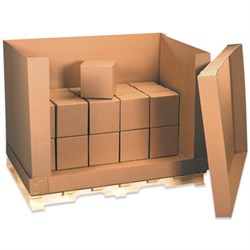
Air-Freight Corrugated Boxes for Compatible Cargo Loads
Air-freight shipping boxes are double-wall kraft corrugated cargo formats identified by constructions such as EH, E, D and regular slotted cartons. Selected products may be paired with or supplied on pallets, while others are box components only. Choose the complete system around the cargo, weight distribution, route, carrier requirements and handling equipment—not the air-freight label alone.
Match the Cargo to the Box and Pallet Footprint
Measure the protected load and account for interior bracing, cushioning, liners and clearance. Keep weight distributed across the base rather than concentrated against one wall or unsupported point. Confirm how the selected construction opens and closes, and verify whether the pallet, lid, bottom or other component shown in the description is included or ordered separately.
For a broader view of large corrugated systems, compare bulk cargo shipping boxes. If the job primarily consolidates smaller cartons inside one outer RSC, a master carton shipper may be the more direct format.
Verify Shipment Rules Beyond the Carton
An air-freight product label does not guarantee acceptance by every airline, forwarder, airport, route or destination. Confirm dimensional and weight limits, pallet requirements, documentation, screening, handling and any dangerous-goods obligations with the responsible carrier and regulatory parties before shipment.
A listed double-wall or ECT description is one input, not a universal load or stacking rating. Moisture, duration, handling, pallet support, closures and load distribution all affect performance. Test the completed unit for the intended distribution cycle and keep any required markings or documents accurate, visible and separate from unsupported package claims.
Air Freight Shipping Boxes FAQs
Do air-freight boxes automatically meet airline requirements?
No. Carrier, route, destination, commodity and handling requirements must be confirmed for the shipment.
Are pallets included with every air-freight box?
No. Verify the exact SKU and all required components before ordering.
What do EH, E and D identify?
They distinguish specific cargo-box constructions; use the exact product description and assembly instructions.
Does double-wall board define a maximum cargo weight?
No. Suitability depends on the complete package, support, load distribution and distribution conditions.
Need Help Choosing Air Freight Shipping Boxes?
Packaging HERO can help you compare cargo dimensions, box construction, components and handling requirements.
Contact Packaging HERO
.webp)