.webp)
 Folding Cartons
Folding Cartons
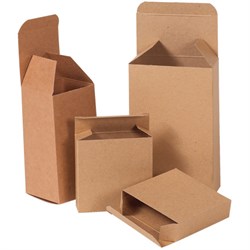

Retail cartons span several constructions with different assembly, storage and presentation characteristics. Standard and 36-point heavy-duty reverse-tuck cartons store flat before use. Two-piece stationery cartons fit paper products, while rigid set-up boxes arrive formed for presentation and organized storage. Choose construction before narrowing the size. Standard folding cartons suit suitable lightweight retail products and can be assembled as needed. Heavy-duty folding cartons use 36-point kraft paperboard for a heavier option, but thickness alone does not establish a universal product-weight or stacking rating. Trial the carton with the merchandise, inserts and closure method. Stationery cartons use separate top and bottom pieces and are sized around business cards, forms, letterhead and related paper products. Rigid set-up cartons arrive preassembled, reducing forming labor but requiring more warehouse space. Their formed construction provides a different presentation, not automatic shipping protection. Add a corrugated outer shipper when distribution conditions require it. Use interior length, width and depth and keep dimension orientation consistent. Allow room for product thickness, tissue, inserts, literature and practical loading without forcing the panels or lid. Too much empty space can allow movement and weaken presentation, while an undersized carton can bow, tear or fail to close. Consider assembly time, closure, labeling, shelf display and storage before approving a carton. Reverse-tuck styles require proper panel sequence and crease handling. Two-piece and rigid cartons need a lid fit that remains secure without crushing the contents. Test the complete retail package and any outer shipper together, especially when the carton will move through parcel distribution. Standard and heavy-duty reverse-tuck folding cartons store flat before assembly. The documented heavy-duty folding cartons use 36-point kraft paperboard. They are two-piece cartons for business cards, forms, letterhead and related paper products. Not automatically. Add an appropriate outer shipper when distribution conditions require it. Packaging HERO can help you compare carton construction, inside dimensions, assembly and presentation needs.
Standard, Heavy-Duty, Stationery and Rigid Set-Up Cartons
Match Construction to Product and Workflow
Size the Inside Around the Complete Pack
Carton Construction Guide
Construction
Workflow Advantage
Confirm Before Ordering
Standard reverse-tuck
Stores flat and assembles at the station
Interior size, product weight and closure
36-point heavy-duty
Heavier kraft paperboard option
Finished load and panel performance
Two-piece stationery
Separate lid and base for paper products
Product format, depth and lid fit
Rigid set-up
Arrives formed for presentation
Warehouse space, fit and outer shipping needs
Folding Cartons FAQs
Which cartons store flat?
What construction is used for heavy-duty cartons?
What are stationery cartons designed around?
Do rigid set-up boxes replace shipping cartons?
Need Help Choosing Folding Cartons?
