.webp)
ErgoStrap Ergonomic Pallet Strapping Systems
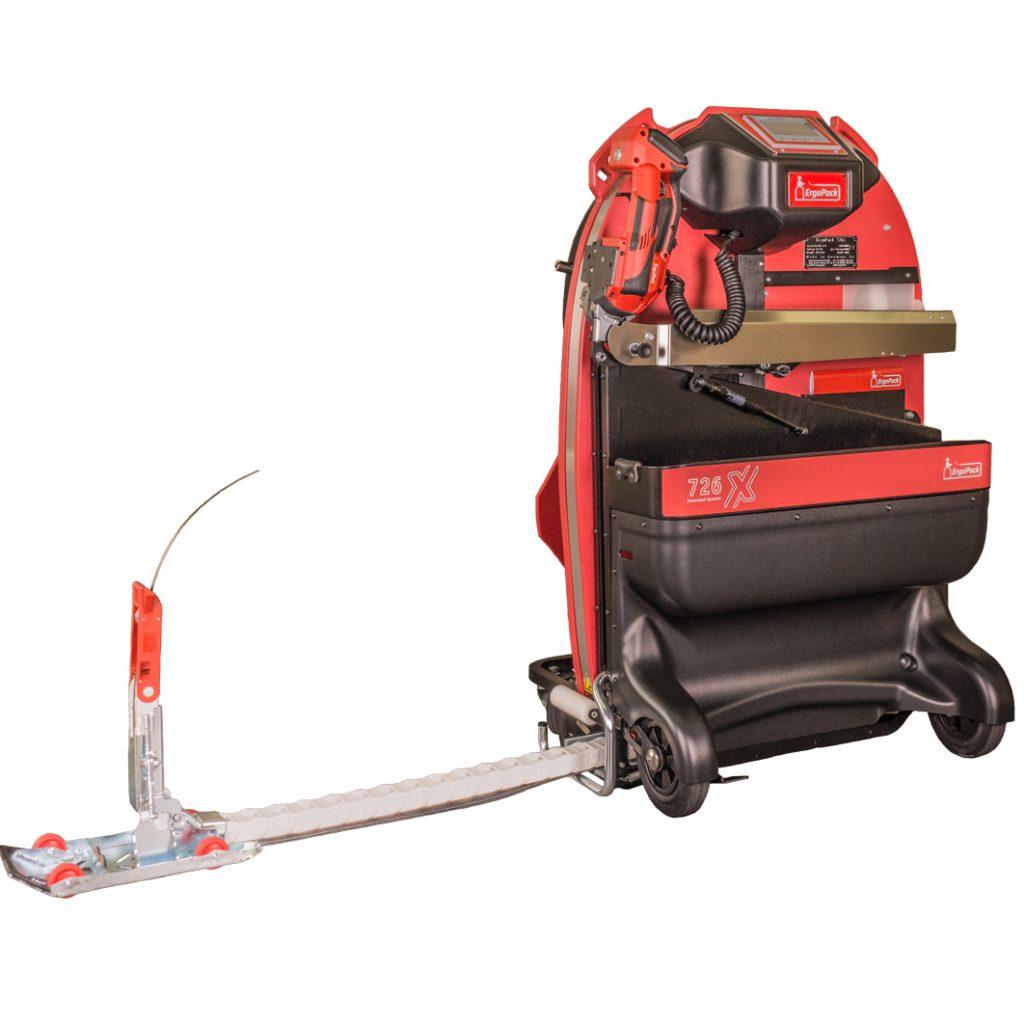
ErgoStrap manufactures mobile pallet strapping systems designed to make unit-load securement more ergonomic and efficient. Instead of manually feeding strap underneath a pallet, bending to retrieve it, and walking around the load, ErgoStrap brings the strap around the pallet and back to the operator.
At Packaging HERO, ErgoStrap becomes especially relevant when pallet strapping is repetitive, physically demanding, or taking more labor than it should. The goal is not simply to automate a step. It is to improve how the operator interacts with the load while still achieving consistent pallet securement.
Where ErgoStrap Fits in a Packaging Operation
Traditional pallet strapping can require an employee to bend down, push or feed strap underneath the pallet, move around the load to retrieve it, and then return to the starting position before tensioning and sealing the strap.
ErgoStrap changes that process. Its ChainLance guides the strap underneath the pallet, up the opposite side, and back toward the operator. The employee can remain primarily on one side of the load while completing the strapping cycle.
How Packaging HERO Evaluates Pallet Strapping
We start with the load and the current securement process.
That means looking at pallet dimensions, load height and weight, product stability, strap type, number of straps per pallet, pallets secured per shift, operator movement, and how the finished load will be handled and transported.
If the current process requires repeated bending, walking around pallets, lifting a strapping tool, or manually feeding strap underneath loads throughout the day, the ergonomics of the process deserve just as much attention as the strapping material itself.
That means looking at pallet dimensions, load height and weight, product stability, strap type, number of straps per pallet, pallets secured per shift, operator movement, and how the finished load will be handled and transported.
If the current process requires repeated bending, walking around pallets, lifting a strapping tool, or manually feeding strap underneath loads throughout the day, the ergonomics of the process deserve just as much attention as the strapping material itself.
Why Companies Consider ErgoStrap
Reduced Bending
The ChainLance feeds strap beneath and around the pallet so the operator does not have to repeatedly bend down to push or retrieve strap underneath the load.
Mobile Operation
Unlike a stationary pallet-strapping machine, ErgoStrap can be moved to the pallet. This makes the system useful where pallets are secured in different locations or cannot easily be brought to fixed equipment.
More Repeatable Strapping
Powered strap feeding, controlled tensioning, an integrated sealing head, and operator guidance can help make the pallet-strapping process more consistent from one cycle to the next.
Pallet Strapping Approaches with ErgoStrap
Mobile Pallet Strapping
The system is moved directly to the pallet, allowing operators to secure loads at shipping, production, staging, or other locations without installing a permanent strapping station.
PP & PET Strapping
ErgoStrap systems can be configured for polypropylene or polyester strapping so the securement system can be matched to the load and application.
Different Pallet & Load Configurations
Different guides, extensions, and system configurations allow ErgoStrap to accommodate a range of pallet styles, clearance heights, and load dimensions.
How the ErgoStrap Process Works
The operator positions the mobile ErgoStrap system in front of the pallet. The ChainLance travels underneath the load and guides the strap up the opposite side, across the pallet, and back toward the operator.
Once both strap ends are accessible, the strap can be tensioned and friction-welded using the sealing head. The result is a pallet-strapping process that eliminates much of the bending and walking normally associated with manually routing strap around a pallet.
Ergonomics Are Part of Packaging Efficiency
Pallet securement is often evaluated primarily by material cost or how quickly a strap can be applied. But repetitive movement also affects the efficiency of the operation.
When employees strap pallets throughout a shift, repeatedly bending to floor level, carrying a sealing tool, and walking around loads can make a simple packaging step much more physically demanding.
ErgoStrap is designed specifically around reducing those movements. For operations with recurring pallet-strapping requirements, improving the operator's interaction with the process can be an important part of improving overall productivity.
When employees strap pallets throughout a shift, repeatedly bending to floor level, carrying a sealing tool, and walking around loads can make a simple packaging step much more physically demanding.
ErgoStrap is designed specifically around reducing those movements. For operations with recurring pallet-strapping requirements, improving the operator's interaction with the process can be an important part of improving overall productivity.
When Mobile Strapping Makes Sense
A fully automatic strapping line can make sense when pallets move through a predictable, high-volume production process. Many warehouses and manufacturing facilities do not work that way.
Pallets may be built in different areas, loads may vary significantly in size, or the operation may not have enough volume at one location to justify fixed automation. A mobile ErgoStrap system can bring powered strapping assistance to the pallet instead of requiring the pallet to come to a dedicated machine.
Common ErgoStrap Use Cases
Manufacturing & Distribution
Facilities regularly securing finished goods can reduce the repeated bending and walking associated with manually feeding strap around pallet loads.
Decentralized Pallet Strapping
When pallets are completed in different areas of a facility, a mobile system can move between locations instead of requiring every pallet to travel to one fixed strapping station.
Ergonomic Process Improvement
Operations reviewing physically repetitive packaging tasks may evaluate ErgoStrap as a way to reduce bending, lifting, and unnecessary movement during pallet securement.
Choosing the Right ErgoStrap System
The right configuration depends on pallet dimensions, under-pallet clearance, load height, strapping material, required tension, number of pallets being secured, and the way pallets move through the facility.
Packaging HERO can evaluate the existing pallet-strapping process and help determine whether a mobile ergonomic system makes sense, which configuration fits the load, and how the equipment works alongside the strapping and other load-securement materials already being used.
Still bending down and walking around every pallet just to apply strapping? Packaging HERO can help evaluate your current pallet securement process and determine whether an ErgoStrap system can improve ergonomics, consistency, and strapping efficiency.
