.webp)
Wulftec Load Containment & End-of-Line Packaging Systems
Wulftec manufactures equipment for the complete end-of-line load containment process, including stretch wrapping systems, automatic strapping equipment, conveyors, pallet handling equipment, and integrated packaging lines.
At Packaging HERO, we often turn to Wulftec for stretch wrapping equipment, but their capabilities go considerably further. When an operation needs to improve how pallets are wrapped, strapped, transferred, accumulated, or moved through the end of a production line, Wulftec gives us multiple technologies that can be engineered to work together.
Where Wulftec Fits in a Packaging Operation
The end of a packaging line involves more than applying stretch film. Pallets may need to be wrapped, strapped, transferred between conveyors, accumulated, stacked, dispensed, or repositioned before they are ready for warehouse handling and transportation.
Wulftec addresses those processes through a combination of stretch wrapping, strapping, pallet handling, and conveying equipment. Individual machines can solve a specific packaging problem, while multiple technologies can also be integrated into a larger end-of-line system.
How Packaging HERO Evaluates End-of-Line Packaging
We start with the pallet and how it moves through the operation.
That means looking at load dimensions, weight, stability, throughput, stretch film or strapping currently being used, containment requirements, forklift traffic, available floor space, operator involvement, and what needs to happen to the load before it leaves the facility.
Sometimes the answer is a standalone stretch wrapper. Other operations may need strapping, conveyors, pallet handling, or several pieces of equipment working together. The goal is to improve the entire process instead of automating one step while leaving bottlenecks around it.
That means looking at load dimensions, weight, stability, throughput, stretch film or strapping currently being used, containment requirements, forklift traffic, available floor space, operator involvement, and what needs to happen to the load before it leaves the facility.
Sometimes the answer is a standalone stretch wrapper. Other operations may need strapping, conveyors, pallet handling, or several pieces of equipment working together. The goal is to improve the entire process instead of automating one step while leaving bottlenecks around it.
Why Companies Consider Wulftec
Multiple Load Containment Technologies
Wulftec combines stretch wrapping, strapping, pallet handling, and conveying capabilities, allowing different parts of the end-of-line process to be evaluated together.
Standalone or Integrated Equipment
Equipment can be used independently to improve a particular process or engineered into a coordinated system that moves, secures, and prepares pallets for shipment.
Solutions That Can Scale
Operations can move from semi-automatic equipment toward more automated wrapping, strapping, conveying, and pallet handling as throughput and process requirements grow.
Wulftec End-of-Line Equipment
Stretch Wrapping
Wulftec offers semi-automatic through fully automatic stretch wrapping equipment, including turntable, rotary arm, horizontal, vertical ring, and specialty systems for different load configurations and production requirements.
Strapping Systems
Automatic vertical and horizontal strapping systems can secure palletized loads and other products, with configurations available for applications that also require compression or integration into an existing production line.
Pallet Handling & Conveying
Pallet dispensers, stackers, transfer equipment, conveyors, and other material-handling solutions help move and position loads around wrapping and strapping processes or replace repetitive manual pallet movement.
Integrated End-of-Line Systems
One of Wulftec's more important capabilities is combining several pieces of end-of-line equipment into one coordinated system. Stretch wrapping, strapping, conveyors, and pallet handling can be engineered around the path the load needs to follow through the facility.
Wulftec also offers integrated strapper-wrapper systems. Depending on the application, a load can receive stretch wrapping, strapping, or a combination of both technologies as part of the same system.
This approach can be especially valuable when an operation is trying to avoid purchasing separate machines and then determining how controls, conveyors, load positioning, and production flow will work together afterward.
Stretch Wrapping: From Hand Wrap to Automation
Hand wrapping can make sense for occasional pallet shipments, but the economics begin to change as volume increases. Employees repeatedly walking around loads and manually stretching film consumes labor, while finished containment can vary from one operator to another.
Wulftec stretch wrapping equipment ranges from semi-automatic machines that still involve the operator in the wrapping cycle to fully automatic conveyorized systems designed for production environments where pallets need to move through the process with minimal intervention.
Turntable or Rotary Arm Stretch Wrapper?
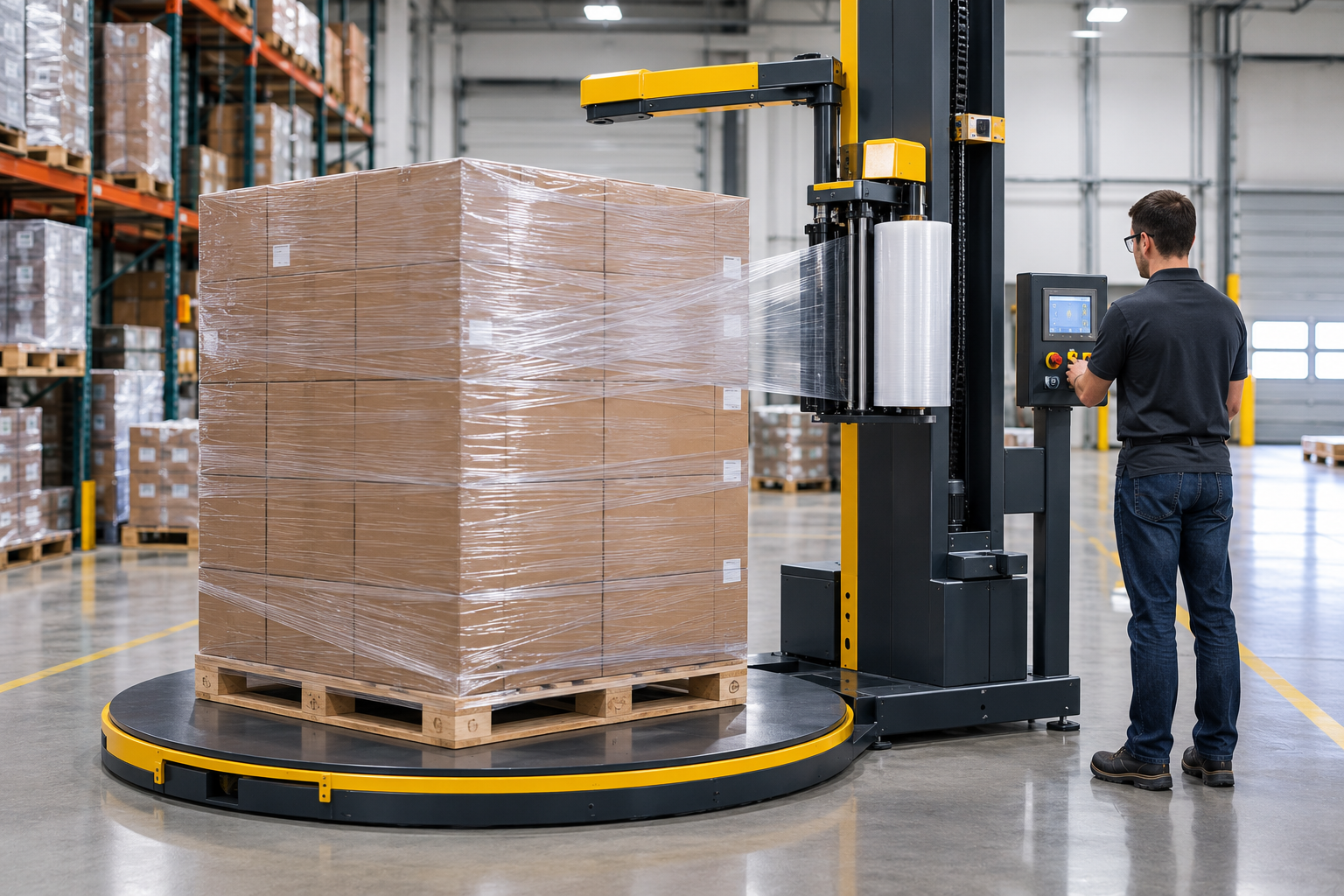
With a turntable wrapper, the pallet rotates while stretch film is applied around the load. These systems can be a practical fit for many stable pallet configurations.
With a rotary arm wrapper, the pallet remains stationary while the wrapping arm travels around it. Keeping the load stationary can be particularly useful when pallets are very heavy, tall, lightweight, unstable, or otherwise difficult to rotate during the wrapping cycle.
Automatic Pallet Strapping
Some loads need more than stretch-film containment. Strapping can provide additional unitization, compression, or reinforcement depending on the product and transportation environment.
Wulftec offers automatic vertical and horizontal strapping systems that can be configured around different load profiles and production lines. When both wrapping and strapping are required, the two processes can also be combined into an integrated system.
Pallet Handling & Conveying
Wrapping or strapping a pallet is only one part of the process. The load also needs to reach the equipment, move between packaging steps, and continue to staging, warehousing, or shipping after securement is complete.
Wulftec's pallet handling portfolio includes conveyors, pallet dispensers, pallet stackers, transfer equipment, pallet inverters, and related systems. These components can operate independently or become part of a larger automated packaging line.
For operations with significant forklift movement or manual pallet handling, improving how loads travel between processes can sometimes be just as important as automating the wrapping or strapping itself.
The Stretch Wrapper and Film Need to Work Together
Installing a stretch wrapper does not automatically create a better unit load. Film characteristics, machine settings, pre-stretch, wrap pattern, containment force, pallet condition, and load stability all influence the finished result.
Packaging HERO can evaluate the machine and stretch film as one system. This can help identify opportunities to improve containment, reduce unnecessary film use, and create a more repeatable process rather than changing equipment or consumables independently.
How Much Automation Does the Operation Need?
More automation is not automatically better.
A lower-volume operation may gain significant benefits simply by replacing hand wrapping with a semi-automatic stretch wrapper. Another facility may need automatic strapping but still move pallets by forklift. At higher throughput, conveyors, pallet handling, wrapping, and strapping may all need to communicate as one production system.
The right level of automation depends on pallet volume, labor, production flow, load variation, available space, required throughput, and the economics of the current process.
A lower-volume operation may gain significant benefits simply by replacing hand wrapping with a semi-automatic stretch wrapper. Another facility may need automatic strapping but still move pallets by forklift. At higher throughput, conveyors, pallet handling, wrapping, and strapping may all need to communicate as one production system.
The right level of automation depends on pallet volume, labor, production flow, load variation, available space, required throughput, and the economics of the current process.
Common Wulftec Use Cases
Moving Beyond Manual Packaging
Operations relying on hand wrapping, manual strapping, or repeated forklift movement can evaluate individual pieces of equipment that reduce labor and improve process consistency.
Difficult or High-Risk Loads
Heavy, unstable, tall, irregular, or demanding pallet loads may require specialized wrapping, strapping, compression, or handling approaches to achieve reliable containment.
Integrated End-of-Line Automation
Higher-throughput manufacturing and distribution operations can coordinate pallet handling, conveying, stretch wrapping, and strapping into a more automated end-of-line process.
Choosing the Right Wulftec System
The right solution depends on more than pallet count. Load stability, weight, footprint, height, production sequence, stretch film or strapping requirements, available floor space, forklift traffic, current labor, and future throughput all influence the recommendation.
Packaging HERO can help evaluate the complete end-of-line process and determine whether the operation needs a standalone stretch wrapper, automatic strapping, pallet handling equipment, conveyors, or an integrated Wulftec system combining several technologies.
Looking to improve more than just the way your pallets are wrapped? Packaging HERO can help evaluate wrapping, strapping, pallet movement, material handling, and automation together to determine which Wulftec equipment fits your end-of-line operation.
