.webp)
How To Measure Poly Bags and Sheeting
Poly bags are measured differently depending on the bag style. A flat bag, reclosable bag, slider bag, gusseted bag, and container liner do not all use the same dimensional convention.
The goal is to measure the usable interior space and then allow enough additional room for the product's thickness, shape, closure, and the fit you want.
How to Measure a Flat Poly Bag
Flat poly bags are commonly listed as:
Width × Length
- Width is measured from side to side across the opening.
- Length is measured from the bottom seal to the open end of the bag.
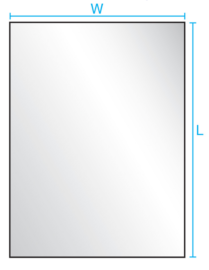
For a flat product, choose a bag slightly larger than the product dimensions so it can be inserted without stressing the side seams.
For thicker or bulky products, width and length both need to account for product thickness. A bag that matches only the face dimensions may be too small once the product has depth.
How to Measure a Reclosable Zip-Top Bag
Reclosable bags are also commonly listed as:
Width × Usable Length
- Width is measured side to side.
- Usable length is measured from the bottom seal to the bottom of the reclosable seal.
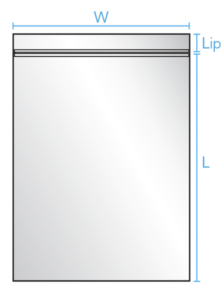
Do not include the area above the zipper when determining how much product space is available.
If the product is thick or rigid, allow additional room so the closure can seal without excessive tension.
How to Measure a Slider Bag
Slider bags are measured similarly to other reclosable bags, but the slider assembly takes up additional space near the opening.
- Width is measured from side to side.
- Usable length is measured from the bottom seal to the bottom of the slider closure area.
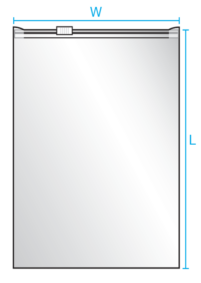
Because the slider hardware occupies part of the opening, rigid or bulky products may require more width clearance than they would in a standard flat or zipper bag.
How Much Extra Room Should You Allow?
There is no universal allowance that works for every product.
The amount of extra space depends on:
- Product thickness.
- Product rigidity.
- Whether corners or edges are sharp.
- Bag gauge and flexibility.
- Whether the bag needs to fit tightly or slide on easily.
- Whether the closure needs additional clearance.
When fit is important, test the product in a sample bag rather than relying on a fixed dimensional allowance.
How to Size a Flat Poly Bag for a Square or Rectangular Container
A flat bag can also be used as a liner for a box, tote, bin, or other rectangular container.
Measure the container:
- Width (W)
- Depth (D)
- Height (H)
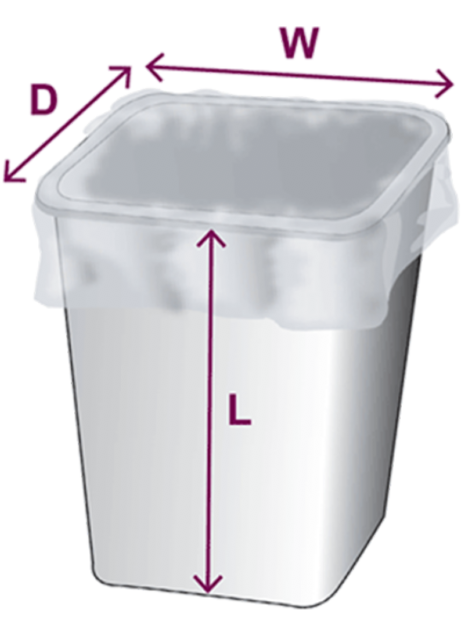
For a flat bag liner, a common starting calculation for the required bag width is:
Bag Width ≈ Container Width + Container Depth
The required bag length needs to cover the container height plus enough material to span the bottom and provide the desired overhang at the top.
The exact overhang should be based on how the liner will be folded over, tied, closed, or used in the application rather than assuming one fixed extra amount for every container.
How to Measure a Gusseted Poly Bag
Gusseted bags have additional material folded into the sides or bottom so the bag can expand around bulky or dimensional products.
A gusseted bag may be described using:
Width × Gusset × Length
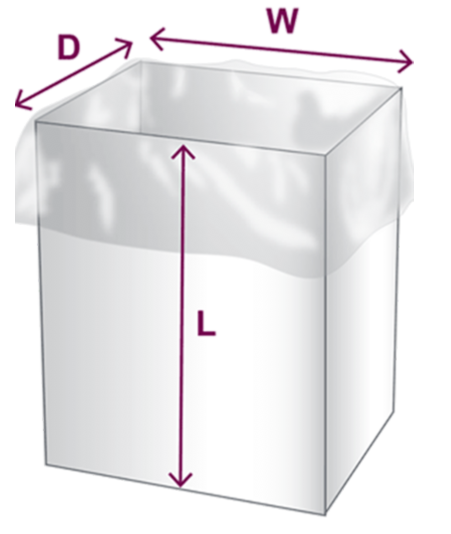
When selecting a gusseted liner for a rectangular container, measure the container width, depth, and height first.
The gusset should provide enough expansion for the container depth, while the bag width must accommodate the remaining face dimension.
Length should include:
- The container height.
- Material needed to cover the bottom.
- Any desired overhang above the container.
Because gusset configurations vary, confirm whether the product is side-gusseted or bottom-gusseted before applying a sizing formula.
Flat Bag vs. Gusseted Bag
A flat bag works well for products with limited thickness or for applications where the film can simply wrap around the product or container.
A gusseted bag can be more practical when:
- The product has significant depth.
- The bag needs to line a box or bin.
- A more rectangular finished shape is useful.
- A flat bag would require excessive extra width.
How Poly Sheeting Is Measured
Poly sheeting is generally specified by:
- Width
- Length
- Thickness or gauge
For roll stock, width refers to the width of the film across the roll, while length refers to the total footage or roll length.
Thickness is typically expressed in mils for many industrial poly products. A higher mil value means thicker film, but the correct thickness depends on puncture risk, load weight, handling, and the application.
How Poly Tubing Is Measured
Layflat poly tubing is commonly specified by:
- Layflat width
- Film thickness
- Roll length
The layflat width is the width of the tubing while flattened. When opened, the tubing forms a sleeve that can be cut to the required product length and sealed as needed.
Remember that a dimensional product consumes part of the available layflat width as the tubing expands around the product.
Common Poly Bag Measuring Mistakes
- Ignoring product thickness: A dimensional product needs more film than its flat face dimensions suggest.
- Including the zipper or slider area in usable length: The closure reduces available interior space.
- Using one fixed fit allowance for every product: Rigid and bulky products need different amounts of clearance.
- Confusing flat and gusseted bag dimensions: Gussets change how the bag expands around the product.
- Ignoring film thickness: Bag dimensions and film gauge are separate specifications.
- Forgetting overhang on liners: Container liners may need additional length for folding, tying, or covering contents.
The Bottom Line
Poly bag measurements depend on the bag style.
Flat bags use width and length. Reclosable and slider bags use usable length below the closure. Gusseted bags add another dimension to allow expansion. Liners must account for the width, depth, and height of the container. Poly tubing and sheeting have their own roll-based specifications.
Measure the product or container first, then account for thickness, closures, gussets, and the amount of clearance the application actually needs.
Need Help Sizing a Poly Bag?
Contact Packaging HERO if you need help choosing a flat bag, reclosable bag, gusseted bag, container liner, tubing, or sheeting size for your application.
Frequently Asked Questions
How are flat poly bags measured?
Flat poly bags are commonly measured Width × Length. Width is measured across the opening, and length is measured from the bottom seal to the open end.
Do I include the zipper when measuring a reclosable bag?
No. Usable length is generally measured from the bottom seal to the bottom of the reclosable seal or closure area.
How much extra space should I add for product thickness?
There is no universal allowance. Required clearance depends on product thickness, rigidity, bag gauge, closure style, and how loose or tight the fit needs to be.
How are gusseted poly bags measured?
Gusseted bags are commonly specified with width, gusset, and length. The gusset provides additional material so the bag can expand around dimensional products or containers.
How is poly tubing measured?
Layflat poly tubing is commonly specified by layflat width, film thickness, and roll length.
