.webp)
Wholesale Top Labels
| Image | SKU | Dimensions | Color/Print | Labels/Roll |
|
Add To Cart | |||||||
|---|---|---|---|---|---|---|---|---|---|---|---|---|---|

|
PH-411283 | 3" x 5" | "No Top Freight" - Fluorescent Yellow | 500 |
|
|
|||||||

|
PH-411293 | 3" x 5" | "Top Heavy" - Fluorescent Red | 500 |
|
|
|||||||

|
PH-411303 | 3" x 5" | "Top Load Only This side Up" - Fluorescent Green | 500 |
|
|
|||||||

|
PH-411313 | 3" x 5" | "Top Load Only" - Fluorescent Red | 500 |
|
|
|||||||

|
PH-411323 | 3" x 5" | "Top Load Only" - Red/White | 500 |
|
|
|||||||

|
PH-411333 | 3" x 5" | "Top Load" - Fluorescent Red | 500 |
|
|
|||||||

|
PH-411363 | 8" x 10" | "Top Load Only" - Fluorescent Red | 250 |
|
|
|||||||
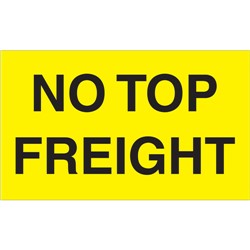

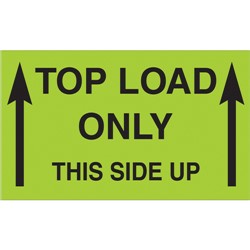


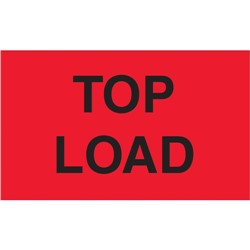

Top load labels communicate where a carton or pallet should be positioned relative to other freight. Options such as “Top Load Only,” “No Top Freight,” “Top Heavy” and “Top Load Only—This Side Up” address placement, overhead load and stability. Choose the message that matches the actual handling restriction. “Top Load Only” requests placement above other freight, while “No Top Freight” tells handlers not to place another unit on top. “Top Heavy” warns that the package may be unstable and does not automatically mean it can support top loading. Combined orientation wording is useful only when the identified face must remain upright. For broader prohibitions such as double stacking, crushing or breaking unitization film, review do not stack labels. Use matching instructions on shipping documents whenever the carrier or internal process supports them. Apply labels to multiple visible sides before the unit reaches the dock. Large fluorescent formats are useful when loaders must recognize the restriction from a distance; smaller labels may be appropriate for cartons moving through parcel operations. Keep the message clear of straps, corners and pallet wrap overlap. Top-load wording does not certify carton compression strength, prevent stacking or guarantee a carrier’s loading position. Build and unitize the shipment for its expected distribution environment, use approved physical controls when necessary and confirm service restrictions before tendering the freight. No. One addresses placement among freight; the other identifies package orientation. It requests that no other freight be loaded above the marked unit. Multiple visible faces improve recognition when loaders approach from different directions. No. It communicates the request and must be supported by carrier arrangements and suitable packaging. Packaging HERO can help you compare placement wording, visibility and label size for your loads.Top Load Labels for Freight Placement and Stability Instructions
Distinguish Placement, Compression and Stability
Place the Instruction Where Loaders Can Act
Top Load Labels FAQs
Is “Top Load Only” the same as “This Side Up”?
What does “No Top Freight” mean?
Should top-load labels appear on more than one side?
Does the label guarantee top placement?
Need Help Choosing Top Load Labels?
